What is the difference between the science fiction and fantasy genres?

This piece originally appeared on Quora.com as an answer to the question, “What is the difference between the science fiction and fantasy genres?”
There’s a bit of yin and yang to the sci-fi and fantasy genres, isn’t there? They’re not related by accident. They aren’t just the two genres that happen to be about things that are not real. No, there is some ouroboros, some magnetic dipole in the relationship, two things bound up in their opposites. It comes down to this: science fiction is a speculative literature of ideas, while fantasy is mythologizing self-expression. They are not mutually exclusive, but they are difficult to combine. The medieval and folkoric aesthetic of fantasy, and the technological aesthetic of sci-fi, are less fundamental to the genres than the italicized points I just mentioned.
Sci-fi, fundamentally, is about taking an idea and then creating a context where that idea can reach full maturity. A good science fiction novel demonstrates an idea in precisely the same way that a physicist would demonstrate a law of physics using a hypothetical, but fictionalized. For example, take Frank Herbert’s Dune. The driving idea behind Dune, it seems to me, is the limits of human potential: what can discipline allow a human being to do? How far can intense focus and self-denial take a person? Dune is full of people who are nearly superhuman, because Herbert created a context where the idea of discipline stretching the limits of human potential could reach full maturity. Herbert’s universe spans thousands of years and multiple planets, and it’s full of conflict, not scale for the sake of scale but to allow his primary idea to reach its highest point. What sort of universe would contain people who are nearly superhuman as a result of honing their potential scientifically? It would take thousands of years and huge swathes of space, and it would take bafflingly complex internecine wars and economic conflict to provide the “Darwinian” backdrop against which humans would be driven to make themselves as powerful as possible. Herbert’s universe is deliberately constructed to create a context where human potential would be stretched to its limit, to give the underlying idea as much room as possible to stretch out and ramify into its full maturity. It is no different from Einstein day-dreaming that he’s riding on a beam of light to demonstrate the principles of relativity.
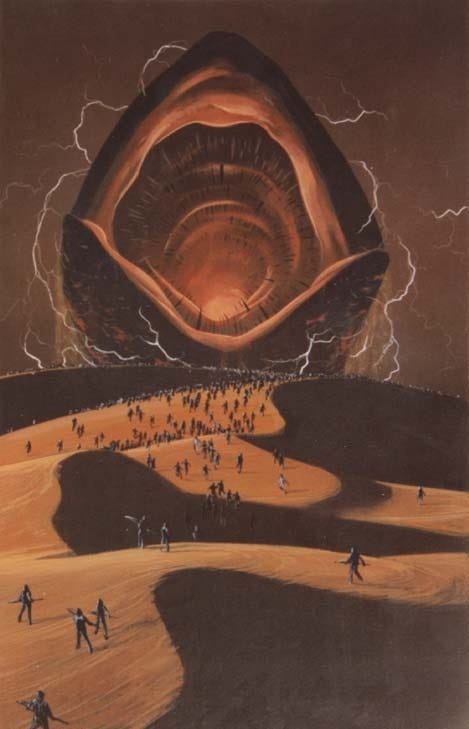
That, by the way, is the key with sci-fi, and it’s the reason why literary snobs often don’t take science fiction seriously: the story, the characters and their motivations, the drama, are all secondary. Really, the story is just there to demonstrate the underlying idea. All of the psychological depth and personal resonance that is primary in “serious” literature takes a back seat in science fiction because sci-fi is a speculative literature of ideas first, and everything else second. Science fiction simply doesn’t do the same thing that other literature does, although I think that Dune,at least, belongs in the canon with all the rest.
Fantasy is a mythologizing self-expression — what J.R.R Tolkien called mythopoiesis — because the point of fantasy is to place an archetypal and mythological significance on whatever is of importance to the author. Like science fiction, fantasy does not do the same thing as other literature, but it is nevertheless a far more personal genre because it’s not about ideas. Tolkien created an imaginary world to provide a mythological significance to the history and culture of Germanic peoples. There is already a Germanic mythology, of course, so Tolkien’s work is, from one perspective, a rehabilitation of Nordic mythology. C.S. Lewis created his fantasy world to do the same thing for Christianity. Michael Ende wrote The Neverending Story as a means of mythologizing Anthroposophic thought. In each case, it’s a matter of creating a mythology as a kind of self-revelation, a lifting of the curtain and showing the bare libidinal motions of one’s deepest values.
It would behoove me to say something about the significance of myth here. Mythology is not necessarily religion (many of the ancient Greeks did not literally believe in their gods), nor is it a set of fairy tales. Myth takes certain characters and events as convergence points, themes that are deeply important to a certain group of people. Superman, for example, is basically a character of American mythology; he’s a symbol of hope, pure-hearted goodness, justice, and strength. What could possibly be more American than Superman? If you take everything that is important in the American self image and distill it down to its brass tacks, then stack it up in a fictional character, you get something very much like Superman. That’s the significance of myth. Myth is a bare essence, if you’re comfortable with that word, of something significant to a group of people.
The mythopoietic nature of fantasy is that it takes whatever is most important to the author and demonstrates it, not intellectually or by way of explanation but by brute, gut-level emotional expression, in such a way that the values of the author can become important to everyone who reads the author’s work. How many people have developed an appreciation for Nordic myth from reading Tolkien? Or even if they haven’t, how many people have read Tolkien and then felt the same way about The Lord of the Rings that Tolkien felt about Beowulf? That’s the key. If you read Tolkien and are moved by the strange sadness and vastness of Middle-Earth, then you are experiencing the same feelings that Tolkien had about Nordic myth, and you understand how he felt because now you’ve felt that way, too.
I said before that fantasy and science fiction are not mutually exclusive, and I think that there are cases where the lines blur. I’m not talking about goofy steampunk novels with magical machine guns or whatever — that is just a vulgar merging of aesthetics that misses the underlying point. Again, I think that a better example is Dune. I speculate that Frank Herbert was awestruck by the possible futures that lay ahead of the human race, by the ways in which we could develop our potential, and Dune mythologizes this feeling by causing us to feel the same way. “Dude, the Bene Gesserit are so cool! I wonder if people could really do that?” Herbert pulls back the curtain on himself by pulling back the curtain on possible future worlds. I further speculate that Herbert was the kind of person to whom ideas mattered a great deal, so the line between science fiction and fantasy blurs here. And for that matter, Tolkien’s Elves are perhaps a bit of science fiction in Middle-Earth, inasmuch as the Elves are some idea that is given maximal room to come to maturity in Tolkien’s universe. Of course, Tolkien was a different fellow from Herbert and his ideas are, as a rule, blurrier, more emotive and archetypal, more like misty watercolors than blueprints, but there is a bit of sci-fi in fantasy as well.
As to how they’re related — well, I think that writing fantasy does something different for the author than writing science fiction. But the best science fiction approaches fantastic mythopoiesis, and the best fantasy approaches the full and total development of ideas. Dune is a sci-fi novel that approaches the grandeur of myth, and The Lord of the Rings is a fantasy novel in which fictional races, languages, and cultures are allowed to flourish and decline just the way ideas do in science fiction.
One last word. It seems to me that many fantasy worlds are really just science fiction with a medieval aesthetic. If you’re reading a fantasy novel where there are definite rules for magic, and wizards use scientific research to figure out the best way to tap into the mana channels or whatever, then you’re really just reading a sci-fi novel set in a medieval world, and the wizards are just physicists in pointy hats. Conversely, some science fiction is really just fantasy. What is Star Wars but George Lucas’ vaguely New Age worldview, mythologized? What are the Jedi and Sith but good and bad wizards using a completely unexplained and mysterious Force? There’s nothing “scientific” about it, and it’s not meant to demonstrate some underlying idea, like an example given by a philosopher. Star Wars is not science fiction at all, but fantasy.